
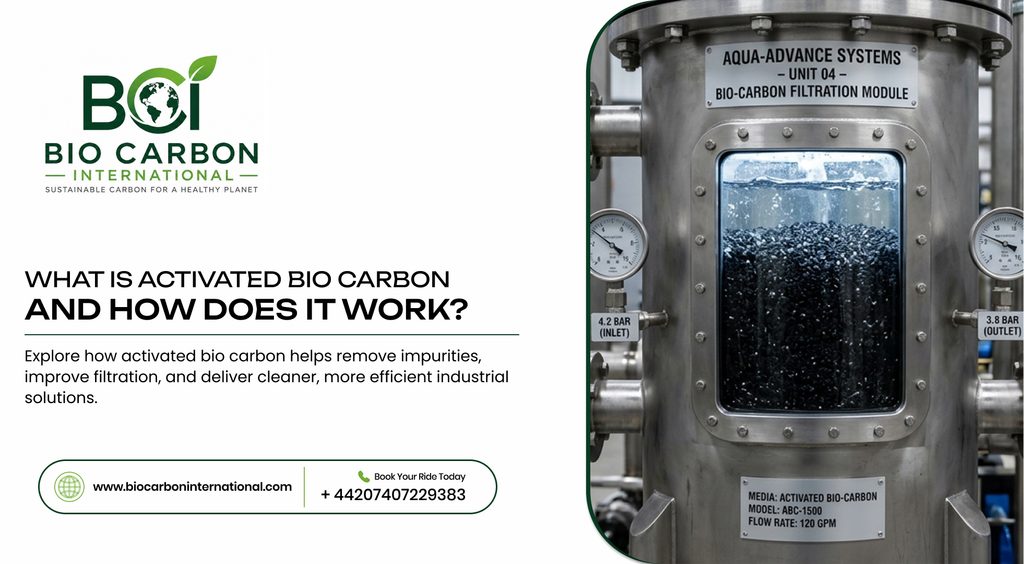
Quick answer: Activated bio carbon is a highly porous carbon material made from renewable biomass (like coconut shells, wood residues, or crop waste) and then “activated” with steam or chemicals to open up millions of microscopic pores. Those pores trap contaminants, odors, and gases through a process called adsorption, which is why it’s used in water treatment, air purification, food processing, and pharmaceutical production.
Think of It as a Molecular Sponge (Sort Of)
Picture a sponge, then shrink the holes down until they’re thousands of times thinner than a human hair. That’s roughly what activated carbon looks like up close.
Activated bio carbon (also called biomass activated carbon, bio activated carbon, or activated biocarbon) is the same functional product as conventional activated carbon. The difference is the starting material. Instead of coal, it begins with renewable biomass, making it a sustainable activated carbon option.
One small teaspoon of good activated carbon can have a surface area comparable to a football field. All that hidden surface is what gives it its power.
How Does Activated Carbon Work?
The key word is adsorption. Note the “d”. It’s not absorption.
- Absorption: a substance soaks into something, like a sponge taking up water.
- Adsorption: molecules stick to the surface of something.
Here’s what happens inside a filter:
- Contaminated water or air flows through the filtration media.
- Impurities travel into the pore structure.
- Weak attractive forces hold those molecules onto the carbon’s internal surfaces.
- Clean water or air exits on the other side.
How does activated carbon remove impurities? It captures organic compounds, volatile organic compounds (VOCs), chlorine, odors, color, and many harmful compounds by trapping them on its enormous internal surface. The more accessible surface area, and the better matched the pore sizes are to the target molecules, the higher the adsorption capacity and filtration efficiency.
A fair limitation: activated carbon isn’t a cure-all. It’s excellent for many organics and gases but less effective on dissolved salts, some metals, and certain small polar molecules. Often it’s one stage in a larger treatment system.
What Is Activated Carbon Made From?
Any carbon-rich organic material can work, but the choice affects performance. Common biomass feedstock includes:
| Feedstock | Typical character |
| Coconut shell | Hard, very microporous, great for gas and drinking water |
| Wood and sawmill waste | Often more mesoporous, good for larger molecules and liquids |
| Agricultural residue (nutshells, husks, fruit stones) | Varies by source, strong circular-economy story |
| Bamboo and other fast-growing plants | Renewable, versatile |
Using biomass waste supports a circular economy: material that might be burned or dumped becomes a high-value filtration product.
How Is Activated Carbon Made From Biomass?
Two main stages turn raw biomass into an adsorbent.
Stage 1: Carbonization
Biomass is heated with little or no oxygen (pyrolysis), driving off moisture and volatiles and leaving a carbon-rich char. At this point, the material has some porosity but not nearly enough for serious filtration.
Stage 2: Activation
This is where the real pore-building happens. There are two routes:
- Steam activation (thermal activation): The char is exposed to steam at very high temperatures. The steam selectively burns away parts of the carbon structure, carving out a network of pores. It’s a widely used, chemical-free method.
- Chemical activation: The biomass is treated with an agent (such as phosphoric acid or potassium hydroxide) and then heated. This can produce very high surface areas and tailored pore structures, though it needs careful washing and handling of chemicals.
The activation process chosen determines pore size, surface area, and ultimately what the carbon is best at removing. That’s why quality suppliers talk about “matching the carbon to the job” rather than selling one-size-fits-all.
Where Is Activated Bio Carbon Used?
Water Treatment
Activated carbon for water treatment removes taste, odor, chlorine, and organic contaminants in drinking water, and polishes effluent in wastewater treatment.
Air Purification
Activated carbon for air purification and gas removal captures odors, fumes, and VOCs in industrial exhaust, ventilation systems, and enclosed spaces.
Food and Beverage Processing
Used to decolorize sugar and syrups, refine oils, and polish beverages, so purity and consistency matter a lot here.
Chemical and Pharmaceutical Production
Helps remove impurities and by-products from process streams and finished solutions, where batch quality is critical.
Environmental Remediation
Activated carbon for environmental remediation treats contaminated groundwater, soil vapors, and industrial emissions as part of pollution control.
Odor Removal
From wastewater plants to waste handling facilities, carbon beds are a go-to for controlling nuisance smells.
Activated Bio Carbon vs Conventional Activated Carbon
| Factor | Coal-based activated carbon | Activated bio carbon |
| Raw material | Fossil coal | Renewable biomass |
| Environmental footprint | Higher fossil carbon input | Generally lower when feedstock is sourced responsibly |
| Performance | Proven, wide range of grades | Comparable to excellent, depending on feedstock and activation |
| Pore character | Often mixed micro and mesopores | Tunable by feedstock; coconut shell is strongly microporous |
| Supply | Large, established | Growing |
| Sustainability story | Limited | Strong, waste-based and renewable |
The honest takeaway: for many applications, a well-made bio-based product performs as well as coal-based carbon. The best choice depends on what you’re removing and your system design.
Activated Bio Carbon vs Biochar
These get mixed up often.
- Biochar is made mainly for soil improvement and carbon storage. It’s typically not activated, so its pore network and surface area are far lower.
- Activated bio carbon goes through an extra activation step to build a deep, engineered pore structure for high-performance filtration.
Same family, different jobs.
Is It Environmentally Friendly?
Mostly yes, with a condition. Compared to coal-based options, eco-friendly activated carbon made from biomass offers:
- A renewable, often waste-derived feedstock
- Lower reliance on fossil carbon
- Support for sustainability goals and ESG reporting
- Potential for regeneration and reuse, which extends service life
The condition: sourcing and energy use during production matter. Ask suppliers about feedstock origin and process efficiency, not just the “bio” label.
What to Check Before You Buy
When choosing an activated bio carbon supplier or manufacturer, ask about:
- Surface area and pore size distribution
- Target-specific tests (iodine number, methylene blue, CTC, or similar, depending on use)
- Ash content and hardness (affects durability and dust)
- Feedstock traceability and certifications (food or drinking-water standards where relevant)
- Batch quality consistency
- Bulk supply capacity and delivery reliability
- Technical support and trial samples
Pilot testing on your own water, air, or process stream beats any datasheet.
Final Thoughts
Activated bio carbon does a simple job extraordinarily well: it traps what you don’t want so that what’s left is clean. Switching the raw material from coal to biomass keeps that performance while adding a renewable, circular angle. Match the carbon to your contaminant, test before you commit, and choose a supplier who can show you the data.
Frequently Asked Questions
What is activated bio carbon?
It’s a porous carbon adsorbent made from renewable biomass and treated through an activation process to create a huge internal surface area for capturing contaminants.
What is activated carbon made from?
Traditionally coal, but also coconut shells, wood, nutshells, bamboo, and other plant-based materials. Biomass-based versions are called activated bio carbon.
Can biomass be used to make activated carbon?
Yes. Many high-quality commercial activated carbons are already made from coconut shell, wood, and agricultural residues.
How is activated carbon made from biomass?
Biomass is first carbonized to create char, then activated using steam (thermal activation) or chemicals to develop a porous structure.
How does activated carbon work?
Through adsorption: contaminants stick to the carbon’s vast internal surface as water or air passes through it.
How does activated carbon remove impurities?
Pores trap organic compounds, VOCs, odors, chlorine, and other unwanted molecules, leaving cleaner water or air.
What is activated bio carbon used for?
Water and wastewater treatment, air purification, odor and gas removal, food and pharmaceutical processing, chemical manufacturing, and environmental remediation.
Is activated carbon renewable?
Coal-based versions are not. Activated carbon from biomass is renewable when the feedstock is sustainably sourced.
Is activated bio carbon environmentally friendly?
Generally more so than coal-based options, particularly when made from waste residues with efficient processing.
How is activated bio carbon different from biochar?
Biochar is mainly for soil and carbon storage and isn’t typically activated. Activated bio carbon is engineered with high surface area for filtration.
How is it different from conventional activated carbon?
The function is the same, but the raw material is renewable biomass instead of fossil coal.