
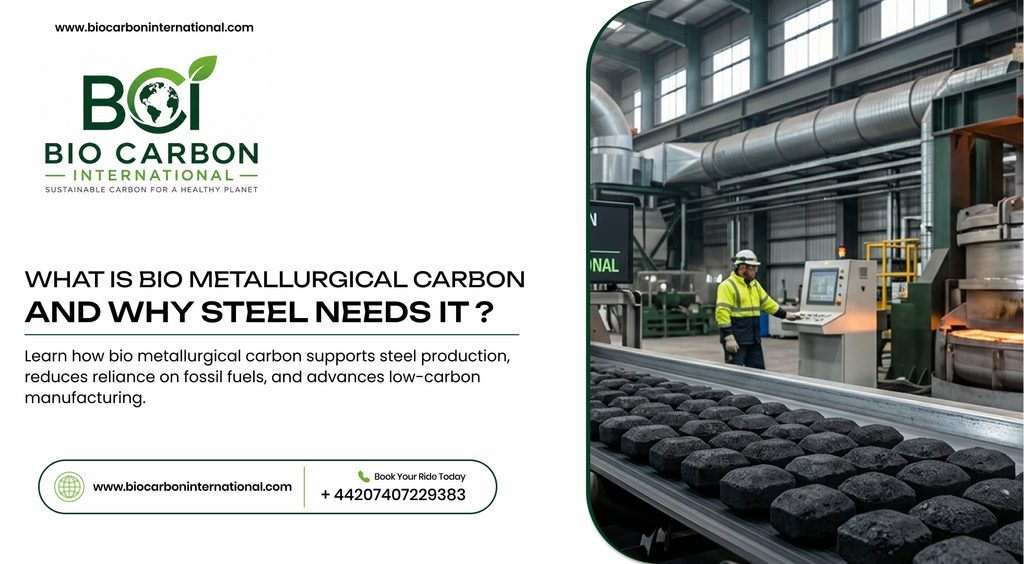
Quick answer: Bio metallurgical carbon is a carbon-rich, low-impurity solid made from biomass (like wood residues or crop waste) through pyrolysis or carbonization. Steel, foundry, and ferroalloy producers use it as a renewable replacement for part of the fossil carbon they burn and react in furnaces. It’s already used in electric arc furnaces, foundries, and ferroalloy plants, and is being tested in blast furnaces.
First, Why Does Steel Need Carbon at All?
Most people think of steel as just iron. In reality, carbon is steel’s co-star, doing three jobs:
- Reductant: Iron ore is iron plus oxygen. Carbon grabs the oxygen and leaves the metal behind. This is the reduction step.
- Fuel: Carbon burns to supply the heat generation furnaces need.
- Alloying ingredient: A little carbon goes into the steel itself to set its strength and hardness.
For over a century, that carbon has come from fossil-based, non-renewable carbon: metallurgical coal and met coke. It works brilliantly, but it’s also a major source of greenhouse gas emissions from heavy industry. That’s the problem bio metallurgical carbon tries to solve.
So, What Is Bio Metallurgical Carbon?
Bio metallurgical carbon (also called biocarbon for steel, biogenic carbon, or renewable metallurgical carbon) is biomass converted into a dense, carbon-rich material built to survive furnace conditions. Its carbon comes from plants that absorbed CO₂ recently, not from coal seams formed over millions of years.
It’s a renewable carbon product, but “bio carbon” is a wide label. The metallurgical version has to meet tougher specs than the kind sold for gardening or general fuel use.
The Spec Sheet Decoder
When you evaluate a bio metallurgical carbon supplier, these are the numbers that matter:
| Property | Why steelmakers care |
| Fixed carbon | Higher means more reducing power per tonne |
| Low ash | Less slag, less waste, cleaner chemistry |
| Low sulphur | Sulphur harms steel quality, and biomass is naturally low in it |
| Low impurities (phosphorus, alkalis) | Protects steel grade and furnace linings |
| Stable carbon structure | Holds up in handling and resists breaking down too early |
| Reactivity and reduction properties | Determines how it behaves in the furnace |
| Size and strength | Affects how it can be charged or injected |
That low sulphur and low ash combination is one of biomass’s natural advantages, provided the feedstock is chosen well.
How Is Bio Metallurgical Carbon Made?
It starts with biomass waste: sawmill residues, forestry offcuts, nutshells, and other agricultural residue. Then comes biomass thermal conversion technology:
- Pyrolysis: Heating biomass with little or no oxygen drives off moisture and volatile gases and leaves a carbon-rich solid. Higher temperatures usually give higher fixed carbon content.
- Carbonization: A controlled, often slower process that produces consistent, high-grade char. For metallurgy, consistency is everything.
The by-product gases can often be captured to power the process itself, which supports the circular economy angle. You’re turning waste into a furnace material and recovering energy along the way.
Where Does Steel Actually Use It?
Here’s the honest, furnace-by-furnace picture.
Electric Arc Furnace (EAF)
This is the easiest entry point. Biocarbon for electric arc furnaces can be injected or charged as a carbon source and used for slag foaming, which helps the furnace run efficiently. It substitutes for fossil carbon additives that EAF operators already buy.
Blast Furnace
Biocarbon for blast furnaces is trickier. Coke does a structural job inside the stack, holding the burden up so gas can flow, and most biocarbon isn’t strong enough for that. So current use focuses on partial roles, like injection through the tuyeres or inclusion in sinter and coke blends. Think “meaningful share,” not “total swap.”
Foundries
Biocarbon for foundries works as a carbon raiser and fuel, with very low sulphur as a bonus for casting quality.
Ferroalloy Production
Biocarbon for ferroalloy production (silicon, manganese, chromium alloys) is a strong fit. These smelters already use carbon as a reductant, and many have long used charcoal, so renewable reductant for furnaces is a natural step.
What About “Bio Coke”?
Bio coke generally means coke-like material made by blending or forming biocarbon (sometimes with coal) into stronger lumps. It’s an active development area aimed at closing the strength gap, but it’s still maturing.
Bio Metallurgical Carbon vs Coal vs Coke
| Met Coal / Coke | Bio Metallurgical Carbon | |
| Carbon origin | Fossil | Biogenic (recently grown) |
| Lifecycle emissions | High | Potentially much lower |
| Sulphur | Moderate to high | Typically very low |
| Mechanical strength | Excellent (coke) | Lower, improving with new forms |
| Supply maturity | Global, established | Scaling up |
| Best use today | Everything | EAF, foundry, ferroalloy, partial blast furnace |
Bio metallurgical carbon vs biochar? Biochar is tuned for soil, filtration, and carbon storage. Metallurgical biocarbon is engineered for furnace performance: high fixed carbon, tightly controlled impurities, and consistent quality.
Why This Matters for Green Steel
Steel is under pressure from regulators, customers, and investors. Environmental regulations keep tightening, and ESG commitments now shape purchasing decisions. Replacing even part of the fossil carbon in a furnace can cut the carbon footprint of each tonne of steel without rebuilding the entire plant.
That makes it a practical tool for low carbon steel production, and a rare “drop-in” option when many other decarbonization routes need huge capital spending.
A fair caveat: “Renewable” only holds if the biomass is sourced responsibly. Residues and waste streams are the gold standard. Always ask for feedstock documentation and lifecycle data.
What to Ask Before You Buy
When talking to a bio metallurgical carbon manufacturer, request:
- Lab analysis (fixed carbon, ash, sulphur, volatile matter, moisture)
- Feedstock source and sustainability certification
- Batch-to-batch consistency records
- Sizing and handling options for your furnace
- Scalable manufacturing capacity for long-term supply
- Trial support, ideally starting with a small blend and expanding as results come in
Final Thoughts
Steel isn’t going away, and neither is its need for carbon. What can change is where that carbon comes from. Bio metallurgical carbon lets producers swap part of their fossil carbon for a renewable one, starting where it fits best and growing as technology and supply mature. Start with a trial blend, check your lab data, and scale up with confidence.
Frequently Asked Questions
What is bio metallurgical carbon?
It’s a renewable, carbon-rich material made from biomass through pyrolysis or carbonization, designed to meet the purity and performance needs of metal production.
What is bio metallurgical carbon used for?
It serves as a reductant, fuel, and carbon source in steelmaking, foundries, and ferroalloy production.
How is bio metallurgical carbon made?
Biomass waste is heated with limited oxygen, which removes volatiles and concentrates the carbon. The process is controlled to deliver high fixed carbon, low ash, and low impurities.
Can biocarbon replace metallurgical coke?
Partially. It can substitute for coke-related carbon in sinter, injection, and some smelting uses, but full replacement in a blast furnace is limited by strength requirements.
Can biocarbon be used in steelmaking?
Yes. It’s used in electric arc furnaces today and is being trialed and adopted in parts of blast furnace operations.
Which industries use bio metallurgical carbon?
Steel manufacturers, foundries, ferroalloy producers, and other metal processing industries.
Can bio metallurgical carbon replace fossil carbon?
In many applications, yes. The extent depends on the furnace type, material specs, and supply availability.
Is bio metallurgical carbon renewable?
Yes, when made from sustainably sourced biomass such as agricultural or forestry residues.
What are the benefits of bio metallurgical carbon?
Lower net emissions, very low sulphur, waste-based feedstock, support for ESG goals, and a practical path to greener steel.